
With an upcoming ISO/IEC 17025 audit, is your autoclave calibration documentation truly “sufficient” and “correct” to pass the NC (Non-Corrected Testing) requirements? Many lab technicians still confuse safety inspections with measurement calibration. This oversight leads to a lack of crucial parameters when presenting to the audit team.
This article is based on the TCVN ISO/IEC 17025:2017 standard to identify the items that require calibration. We will clarify the technical requirements to help you maintain sustainable laboratory capabilities. This will allow you to confidently optimize equipment management processes within your facility.
1. Equipment Requirements and Measurement Linkage
Sections 6.4 and 6.5 of ISO 17025
As stipulated in Section 6.4, laboratories must establish calibration programs for equipment that directly affects test results. This ensures that all measurements maintain the necessary accuracy throughout the operation. If our equipment is not controlled, all subsequent analysis results become invalid.
Furthermore, Section 6.5 emphasizes the importance of measurement linkage. All calibration certificates must be traceable to the International System of Units (SI) through an unbroken chain of connections. This ensures that measurements are globally consistent and recognized by international organizations.
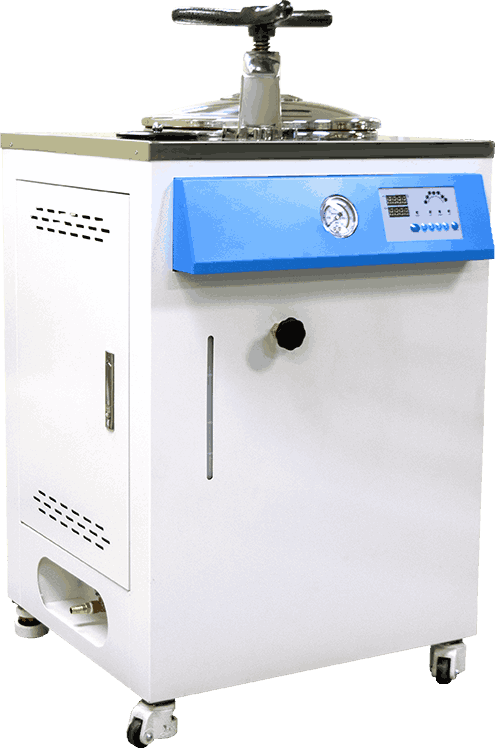
In particular, modern equipment such as the 103-liter Self-Filling Autoclave, SJ-FW100, from South Korea, requires clear documentation before being put into use. Owning a properly certified device from the start will save you considerable time when preparing legal documents.
Compliance with ISO/IEC 17025 calibration standards makes your autoclave more reliable
2. Required Temperature and Pressure Parameters
2.1. Temperature Accuracy Calibration
Temperature is a core factor determining the ability to kill microorganisms in an autoclave. According to standards, calibration is usually focused on key points such as 121°C and 134°C. These are the most common temperature thresholds used in medicine and laboratories today.
Temperature mapping is an indispensable requirement to assess uniformity throughout the entire autoclave chamber. Experts will use 9 to 11 independent temperature sensors placed at critical points. This helps us accurately identify the “coldest zone,” where the risk of not achieving sterilization standards is highest.
2.2. Pressure and Time Control
Saturation pressure plays a crucial role in transferring heat deep into the core of the sample. Therefore, parallel pressure and temperature calibration is mandatory to ensure system consistency. You can learn more about how to accurately control pressure in the autoclave to optimize operational efficiency.
Besides physical factors, the timer also needs to be checked for errors periodically. If the sterilization time is shortened compared to the setting, the sterile accuracy (SAL) will not be guaranteed. The coordination between temperature, pressure, and time is the “three pillars” that help you pass all rigorous inspections.
3. Frequency and Schedule of Periodic Calibration
Establishing a Calibration Cycle
Based on Section 6.4.7, the laboratory must establish a specific calibration program and have regular reviews. Typically, a 12-month cycle is a common interval adopted by many units in Vietnam. However, if our equipment operates continuously 24/7, shortening the cycle is absolutely necessary.
| Situation arises | Required action |
| After repairing the heating element (Heater) | Recalibrate the temperature immediately |
| Move the equipment installation location | Check and recalibrate stability |
| Replace the sensor or controller | Perform a full calibration of temperature and pressure |
4. IQ OQ PQ Validation and Technical Documentation
The Link Between Validation and Calibration
Understanding what IQ OQ PQ validation for laboratory autoclaves entails will help you manage your equipment more comprehensively. Calibration is only one part of the PQ (Performance) process, which aims to demonstrate that the equipment operates as expected. This combination creates a robust quality management system in line with ISO principles.
According to Section 7.5, all technical documentation, including calibration results and repair logs, must be carefully maintained. High-end models like the SJ-FW100 incorporate PID controllers, making data retrieval easy. This reduces the burden of manual record-keeping for lab technicians.
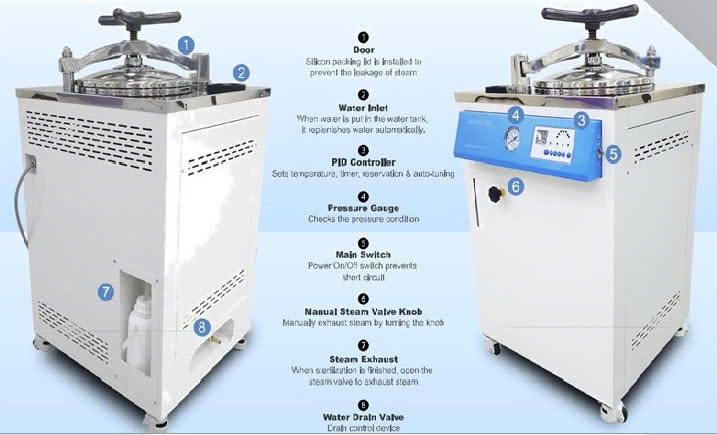
The PID controller (3) plays an important role in calibrating the autoclave according to ISO/IEC 17025
5. Risks of Non-Compliance with ISO 17025 Calibration
Parameter Deviations and Biosafety
Ignoring calibration can lead to negative temperature deviations, resulting in incomplete sample disinfection. This poses an extremely serious risk of cross-contamination in biological or medical research. Additionally, safe methods to prevent water depletion during autoclave operation are crucial to protect the heating element.
Legally, a lack of a valid calibration certificate can lead to the revocation of your lab’s VILAS certification. Some key risks include:
Rejected test results due to lack of calibration consistency.
Risk of fire or explosion due to actual pressure exceeding the control limits of a faulty sensor.
High repair costs when equipment operates with prolonged inaccuracies.
6. Choosing reputable equipment and calibration units
Advantages of the SJ Clave autoclave series
SJ Clave, a South Korean company, has over 30 years of experience in the field of sterilization equipment manufacturing. The SJ-FW100 model is a testament to its durability with a high-grade stainless steel sterilization chamber. The robust door design prevents pressure leaks, ensuring absolute safety for the operator.
| Technical Specifications | Model SJ-FW100 |
| Chamber Volume | 103 Liters |
| Control System | PID Digital Control |
| Operating Cycle | Fully automatic (Water filling – Sterilization – Draining) |
Conclusion
Calibration is not just an activity to meet ISO 17025 audit deadlines. It is essentially a protective barrier for the reliability of all research results in your laboratory. By carefully controlling temperature, pressure, and time, we are protecting the reputation of our own organization. If you are looking for a standard sterilization solution, contact Duc Duong immediately for advice on genuine SJ Clave autoclaves.
DUC DUONG SCIENCE AND TECHNOLOGY COMPANY
Address: 1014/67 Tan Ky Tan Quy, Binh Hung Hoa Ward, Binh Tan District, Ho Chi Minh City
Tel: (028) 3762 8042 – 3762 8043 – 3750 8514 – 3750 8793
Fax: 028 37628043
Email: ducduong@ducduongco.com
Website: ducduongco.com
ZALO OA: DUC DUONG SCI
FAQ
1. What is the difference between autoclave calibration and autoclaving?
Calibration focuses on determining the error and uncertainty of the equipment. Meanwhile, autoclaving is the assessment of whether the equipment meets the mandatory technical standards of the State.
2. Is calibration necessary for a newly purchased autoclave?
Absolutely necessary. All new equipment must be calibrated before being officially put into operation in an ISO 17025 lab to establish an initial baseline.
3. What should I do if the SJ-FW100 autoclave has temperature errors?
You can recalibrate the parameters via the machine’s PID controller. However, please contact Duc Duong’s technicians for the most accurate calibration support.
4. Is calibration cost usually calculated per measurement point or per machine?
The cost is usually calculated based on the number of sensors used for temperature mapping and the required pressure thresholds.
5. How long should calibration records be stored?
You should store records for at least 3-5 years or for a full evaluation cycle by the accreditation organization to ensure traceability.